
Easter Chocolate is More Expensive and Smaller
The Price Higher If We Do Nothing
As Australians face an Easter with dramatically increasing chocolate prices, research shows they are asking: Why is the increase so far above inflation?
Cocoa prices quadrupled to above US$14,500 per tonne in the beginning of 2025, driven by poor harvests, disease, and extreme weather in West Africa (where 70% of the global supply of cocoa comes from). It has since fallen to below US$3,000. But chocolate companies were quick to pass costs on. Even at their peak, higher ingredient costs added only 20–30 cents per 100g to the cost of making Cadbury Dairy Milk — yet the retail price rose by $1.15 or more per 100g, a jump of 65 per cent. Farmers receive an estimated 6-7 per cent of the final chocolate price.
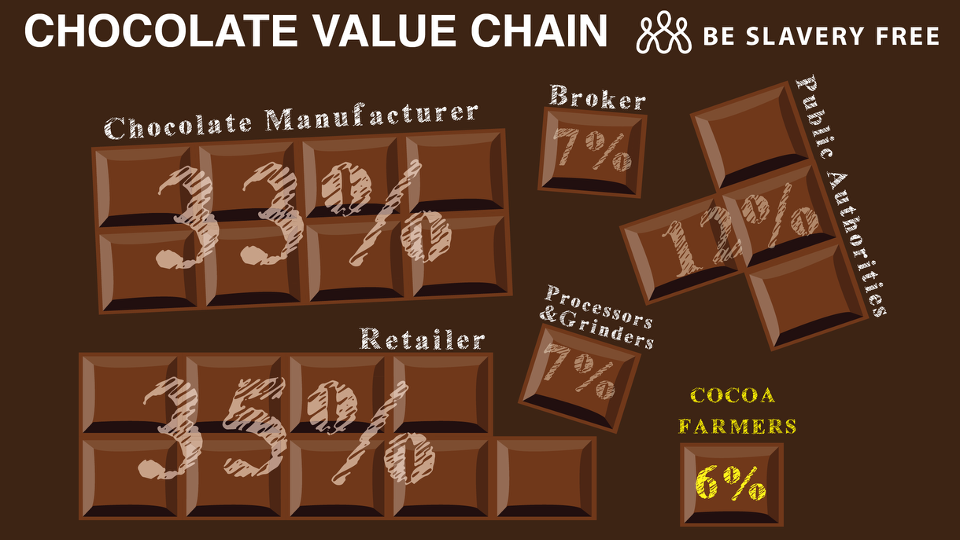
Chocolate bar divided by % of taking at each stage of the value chain
Shrinkflation: Not a small issue
Rather than raising prices transparently, manufacturers have turned to shrinkflation. CHOICE Magazine found Cadbury Dairy Milk hollow eggs went from a 408g pack for $12.50 in 2024 to 340g for $18 in 2026—a 73 per cent unit price increase in two years. Freddo Easter eggs cost 62 per cent more per 100g than a standard Freddo bar. Despite cocoa prices falling from their peak, chocolate has not become cheaper or even remained the same size.
Are farmers seeing any of this?
No. In West Africa, where 60-70 per cent of the world’s cocoa is grown, the vast majority of farmers still don’t earn a living income. In Ghana and Côte d’Ivoire, many of the 2 million or more cocoa farmers survive on as little as $3 a day — and need three to five times their historical income to reach a living income (the minimum amount needed for a decent standard of living in their location). Producing country Governments fix the farmgate price, so high futures prices don’t automatically reach farmers. The industry has had decades to fix this and has chosen not to.
Child labour persists
An estimated 1.56 million children in child labour in cocoa regions of Côte d’Ivoire and Ghana according to the latest research available. While you spoil your children with Easter chocolate this weekend, remember the children forced to grow and harvest that cocoa just so they and their families can survive. When families can’t afford to hire workers or pay school fees, it is their children who pay the real price — in lost childhoods, lost education, and broken futures.
Price isn’t the only thing to consider
The Chocolate Scorecard, run by Australian NGO Be Slavery Free, does the vigorous research with subject matter experts to help consumers shop with their values and to choose their chocolate according to what companies are actually doing to address child labour, environmental destruction, and poverty. The 6th edition Scorecard confirms the industry continues to fall short.
“Companies are happy to use rising cocoa prices to justify charging you more, but those price rises aren’t reaching the farmers and families who need them most,” says Fuzz Kitto, Co-Director of Be Slavery Free. “Shrinkflation is just the visible trick. The deeper problem is an industry that profits from poverty and child labour while telling consumers their hands are tied. They’re not. The Chocolate Scorecard shows which companies are genuinely showing leadership— and which are just talking.”
If chocolate costs more, should the people who grow the cocoa be getting paid more too.
Contact
Fuzz Kitto, Co-Director Be Slavery Free
+61 438 040 959
Fuzz.kitto@beslaveryfree.com
https://www.beslaveryfree.com/
About the Chocolate Scorecard
The Chocolate Scorecard is the world’s most comprehensive independent assessment of around 93% of the chocolate sector, rating them on their policies, actions and evaluations across child labour, living income, deforestation and climate, and traceability and transparency. It is a free, publicly available tool at chocolatescorecard.com It empowers consumers, retailers, and companies to understand what is happening and what needs to develop more. It follows Be Slavery Free’s “name and fame” approach to engaging with the chocolate industry. https://www.chocolatescorecard.com/
About Fuzz Kitto
Fuzz Kitto is Co-Director of Be Slavery Free, an Australian based NGO working to end modern slavery in global supply chains. A recognised expert in ethical trade and corporate accountability, Fuzz has spent over 15 years advocating for cocoa farmers and working with businesses, governments, and civil society to drive systemic change in the chocolate industry – particularly in prevention and mitigation.
References:
– 6th Edition Chocolate Scorecard, chocolatescorecard.com
– Alexander, P. (2025) “The cost of chocolate is soaring, but blaming cocoa prices doesn’t give the whole picture,” The Conversation.
– McBain, D. (2024) “The cocoa price has doubled in mere months, but it shouldn’t add much to the price of chocolate,” The Conversation.
– Treuen, J. (2026) “Eggs-tortion racket: Why Easter chocolate makes me hopping mad,” CHOICE Magazine