
ACCC Clarifies How Businesses Can Work Together to Tackle Modern Slavery
Last week, the Australian Competition and Consumer Commission (ACCC) updated its guide to sustainability collaborations and Australian competition law. For the first time, it includes modern‑slavery‑focused case studies—clear, practical examples of low‑risk collaboration that businesses can use to share information, investigate harms, build supplier capacity, and set voluntary standards without breaching competition rules.
This is a big deal. For years, uncertainty around competition law created a chilling effect: even when a company found credible evidence of modern slavery with a supplier, warning peers could be seen as “cartel” behaviour. The updated guidance helps remove that barrier by showing how to collaborate safely and what guardrails to use. It reinforces that many sustainability collaborations won’t raise competition concerns—and where risks do arise, exemptions and authorisation pathways exist.
Why This Matters
Modern slavery is complex and deeply embedded in global supply chains. Rescuing victims is essential, but systemic change happens when exploitation becomes unprofitable and untenable. That requires businesses to pool knowledge, align expectations, and act jointly—especially when they share suppliers. The ACCC’s update recognises that collaboration can deliver public benefits and provides practical clarity so companies can act without fear of breaching competition law.
What’s in the Updated Guidance?
The ACCC’s publication—Sustainability collaborations and Australian competition law: A guide for business—was first released in December 2024 and updated on 5 December 2025 to incorporate new modern slavery case studies and clarify an existing one. It sits alongside a Quick Guide and a five‑step checklist that help organisations quickly assess competition‑law risk and available exemption routes (e.g., authorisation, class exemptions, notifications).
The New Modern‑Slavery Case Studies
The following scenarios are now allowed under the ACCC Guidelines.
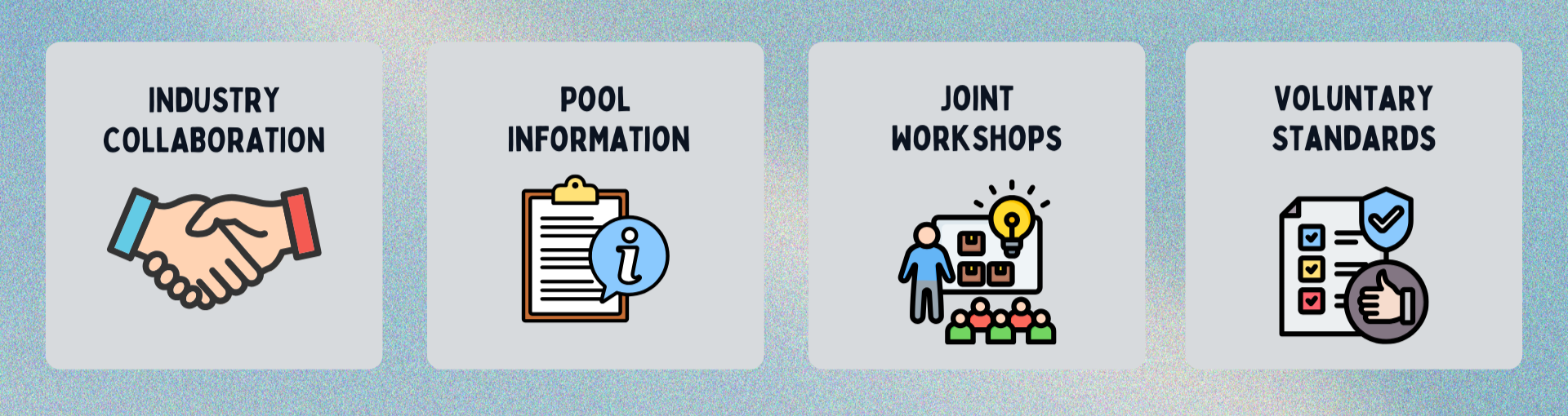
1) Collaborative modern slavery risk management activities (Case study 6)
Industry participants—including competitors—agree to work together to reduce the likelihood that their industry is sourcing from suppliers engaged in modern slavery. They develop a protocol that allows:
Individual or joint audits of supply chain partners.
Notification to other participants if a supplier is credibly engaging in modern slavery.
Sharing only necessary information for the objective.
Independent business decisions by each participant.
No disclosure of how each participant will use the data.
Voluntary participation.
2) Identifying modern slavery risks, investigating suppliers suspected of engaging in modern slavery and addressing identified issues (Case Study 9)
A company receives allegations of worker exploitation by a supplier and finds evidence of forced labour indicators (e.g., retention of identity documents). The company is part of an industry collaboration—some members are competitors—operating under a protocol that allows pooling objective, evidence-based information about suppliers’ modern slavery risks, notifying members of identified risks, and sharing remediation progress. Members agree not to share commercially sensitive data, make independent business decisions, and keep participation voluntary.
3) Joint workshops to educate suppliers on responsible recruitment (Case Study 10)
Industry participants—including competitors—agree to jointly fund and host a series of workshops focused on responsible recruitment of migrant workers. The workshops are designed and delivered by an independent expert, and each participant invites its suppliers (some of which supply to multiple participants). A protocol governs the collaboration, ensuring:
The scope is strictly limited to responsible recruitment practices.
No sharing of commercially sensitive information (e.g., prices, volumes, costs).
Each participant makes independent business decisions about how to use the information.
Participation is voluntary.
4) Voluntary supplier standards, verification processes, good practice guidance, and a commitment for modern slavery objectives (Case study 11)
Members of an industry collaboration—including competitors—work together to develop voluntary supplier standards and buyer verification processes to harmonise modern slavery risk management across the sector. They also create a non-binding good practice guide for due diligence and make a voluntary commitment to work toward a joint target for reducing modern slavery risks.
Key features:
Standards and verification processes are public, non-binding, and voluntary.
Each business decides independently whether and how to adopt them.
Progress toward the joint target is disclosed annually, but participation is voluntary and members choose their own measures.
Guardrails the ACCC Emphasises
No sharing of commercially sensitive information (prices, margins, volumes, future tenders).
Keep participation voluntary; avoid agreements to refuse to deal or allocate suppliers/customers.
Document the purpose and scope: worker protection, remediation, capacity‑building.
Consider exemptions (authorisation, class exemptions, notifications) where risk is higher; the ACCC encourages early engagement.
What Businesses Should Do Now
Read the ACCC’s guide and Quick Guide and assess your collaboration plans against the low‑risk examples and guardrails.
Design collaborations for worker impact, not market control—focus on risk identification, remediation transparency, and capacity‑building.
Engage early with the ACCC if you think your initiative may need authorisation or an exemption; the Commission has an open‑door policy for sustainability collaborations.